
Commodities
Copper Prices Caught Between AI Demand and Tariff Risks: What to Watch Next

Copper is having a volatile, yet positive year, as it grapples with divergent forces. Trump’s tariffs threaten the global economy and copper consumption, just as the AI boom and the clean energy transition support structural demand.

What Drives Copper Prices in 2025?
The Artificial Intelligence boom and the global shift to renewable energy are two of the primary catalysts driving copper demand - and prices - higher in 2025. Copper is indispensable in these transformational trends, with heavy usage in semiconductors and data centres powering AI, as well as in electric vehicles (EV), solar power systems, and other clean energy technologies.
Big Tech players like Meta Platforms and Microsoft, alongside Chinese giants such as Alibaba, are ramping up investment in AI infrastructure. Meanwhile, the transition away from fossil fuels maintains momentum globally, adding further support to long-term copper usage.
At the same time Trump tariffs offer a two-way driver. The prospect of U.S. import levies on the non-ferrous metal has prompted a surge in demand, as buyers scramble to front-run potential costs. However, the broader tariffs policy raises risks of a global economic slowdown. This can limit consumption of a metal that is used in everything from home construction to public infrastructure projects, while this year’s supply-demand dynamics could prove challenging.
Learn more about how to trade commodities.
AI Boom Fuels Copper Demand
The Artificial Intelligence boom, sparked by the release of OpenAI’s ChatGPT more than two years ago, continues to drive massive investments in computing power - and, by extension, demand for copper. The growth in AI workloads fuels demand for semiconductors and data centres, both of which rely heavily on copper for power distribution, cooling, and connectivity.
According to the World Semiconductor Trade Statistics (WSTS), global chip sales are forecast to grow by 11.2% this year [1]. Meanwhile, Moody’s expects global data capacity to surge again in 2025 [2], and the International Energy Agency (IEA) projects an increase of 133% by 2030, reaching 226 gigawatts [3].
The emergence of more cost-efficient AI models, such as DeepSeek’s large language model (LLM), has raised questions about the need for massive capital expenditures. However, it has also intensified competition. Chinese tech giants Alibaba, Tencent, and Baidu are accelerating their AI efforts, prompting US Big Tech to double down on spending. While the cost of training may decline, inference workloads are expected to multiply. This shift is likely to sustain infrastructure demand, and with it, ongoing copper consumption.
The scale of investment underscores this trend:
- Alibaba has pledged over RMB 380 billion (approximately USD 53 billion) towards AI infrastructure over the next three years. [4]
- Meta Platforms has raised its 2025 capital expenditure forecast to $64–72 billion, an increase of at least 63% year-on-year. [5]
- Alphabet has reaffirmed a planned 47% rise in capital spending, to $75 billion. [6]
- Microsoft expects further growth in the fiscal year beginning July, from the current $80 billion, albeit at a more moderate pace.[7]
In short, the AI boom is here to stay. For copper, this means a new and lasting source of support from a fast-evolving sector. Yet, there are still doubts over the actual productivity gains from AI, while the buildout of data centres could face energy constraints.
Clean energy transition provides tailwinds
The shift towards renewables is another trend supporting copper demand. The commodity is used heavily in the production of electric vehicles (EVs), charging stations, photovoltaics, wind farms, and other applications. According to the International Energy Agency (IEA), the market for key energy transition minerals is set to more than double by 2040 – and copper is the only of them “present in all of the most important clean energy technologies”. [8]
The IEA also expects renewables to overtake coal-fired generation globally this year. From 2025 to 2027, electricity generation from renewable sources is projected to grow at a compound annual growth rate (CAGR) of 10.4% [9]. The European Union has set a goal of deriving 45% of its power from renewables [10], while electric cars, electric batteries, and solar energy constitute Beijing's new "three pillars" of growth.
Although EV sales slowed in 2024 due to high interest rates, inflation, and price premiums, 2025 may offer a more supportive environment. As pointed out in the Top 5 EV Stocks for Q2, central banks across major economies are cutting rates, and automakers are pivoting to more affordable EV models to reignite consumer demand. Renault and Stellantis-owned Fiat are among the frontrunners, Tesla has also promised a cheaper model, while Chinese rivals like BYD offer really low entry points.
Early-year sales reflect the strong momentum:
- Battery electric vehicle (BEV) registrations surged 17.1% year-on-year in the EU and 43.2% in the UK, according to the ACEA. [11]
- Strategy& by PwC found a 55% year-on-year increase in China. [12]
- The Kelley Blue Book also recorded growth in US sales, of 11.4% year-on-year. [13]
However, Trump’s return to the White House can slow EV proliferation and the path to net zero. He is committed to fossil fuels and has pledged to roll back his predecessor’s green policies. In his inaugural address, the US President pledged to revoke the electric vehicle mandate, which along with tariffs can hurt the industry and push prices higher. [14]
Nonetheless, with structural decarbonisation trends in motion across Europe, China, and other major economies, copper remains well-positioned to benefit from the global clean energy buildout.
Tariffs: Catalyst and constraint for global copper demand
US President Donald Trump has introduced sweeping new tariffs targeting key trade partners and strategic sectors, including steel and aluminium. While copper is not yet directly affected, the President has signed an executive order to explore tariffs on copper imports, aiming to boost domestic production and curb China’s dominance in critical minerals, in order to protect national security [15]. Commerce Secretary Lutnick reinforced this intention, stating unequivocally on Fox News that the President is “going to add copper to that mix too”. [16]
These signals have sparked a buying surge, as traders and industrial users try to front-run potential levies. Data from the London Metal Exchange (LME) show a declining trend in copper inventories, alluding to increased US-led buying [17]. These dislocations can lead to a tighter market ahead and further support copper prices.
However, the broader tariffs policy pursued by President Trump raises the risk of a global economic slowdown that could constrain the need for copper down the road, with prices taking a nosedive after the so-called Liberation Day. The International Monetary Fund (IMF) lowered its world GDP growth for 2025 considerably, to 2.8% [18]. China, the world’s top copper consumer, reported a sharp contraction in factory activity last month, while the US economy shrank in Q1, with consumer and business sentiment weakening.
That said, Washington has walked back many of these measures and look to strike agreements with trading partners, potentially reducing the economic impact. In a significant step, the US and China agreed to slash tariffs by 115% for a 90-day period [19], easing tensions and offering temporary relief. Still, trade uncertainty persists, keeping copper markets on edge.
Copper market faces mixed supply and demand signals
The Artificial Intelligence boom, the global push towards net zero, and the prospect of new tariffs all offer both near-term and structural support for copper demand. The International Copper Study Group (ICSG) forecasts 2.4% growth in refined copper usage this year[20], while the United Nations warns that supply will struggle to keep pace in the years ahead. To meet a projected 40% increase in consumption by 2040, the UN estimates the need for 80 new mines and $250 billion in investment this decade. [21]
However, the 2025 supply-demand outlook is far more nuanced. While the ICSG maintains a positive consumption forecast, it has revised it lower due to "uncertainty surrounding international trade policy", which is expected to weaken the global economy and "negatively impact copper demand". At the same time, the group anticipates that refined copper production will outpace demand, resulting in a surplus of 289,000 tonnes this year.
Activity among major miners supports this view. Although several producers reported lower output in the first quarter, most expect to ramp up production this year:
- Codelco projects output of 1,370–1,400 kilotonnes in 2025, a year-on-year increase of at least 3.16%. [22]
- Barrick Mining Corporation (formerly Barrick Gold) expects production to rise between 2.6% and 18%, reflecting its strategic shift into copper. [23]
- Freeport-McMoRan reaffirmed its target of a 5% increase in copper sales. [24]
- Anglo American guides for at least a 3% rise in output. [25]
This increase in supply, combined with softening demand expectations amid trade uncertainty, poses a downside risk to prices in the near term. Still, copper’s structural role in the clean energy transition and digital infrastructure buildout suggests that longer-term fundamentals remain supportive.
Copper resilient amid AI and tariff crosscurrents
Copper prices remain at the centre of competing market forces in 2025. On one hand, President Trump’s disruptive policies threaten to slow global growth and weigh on copper demand, just as the market faces a projected supply surplus. These factors dim the copper outlook, raising downside risks.
On the other hand, the prospect of tariffs on US copper imports has triggered a near-term demand spike, as buyers seek to front-run potential levies. This coincides with a broader structural demand, tied to Artificial Intelligence (AI) infrastructure and the clean energy transition. Both trends rely heavily on copper, as the metal is indispensable in semiconductors, EVs, and renewable energy systems.
These conflicting forces have created volatility in copper markets and increased trading interest, with volume among clients* almost quadrupling in the first four months of 2025, compared to the same period last year. After hitting all-time highs in Q1, copper prices corrected sharply, only to rebound and recover much of the lost ground. With tariff headwinds looming, copper remains vulnerable to dips below $4,000. Yet, AI and clean energy demand, as well as prospects of trade deals, sustain the bullish bias and keep it on track for new record highs.
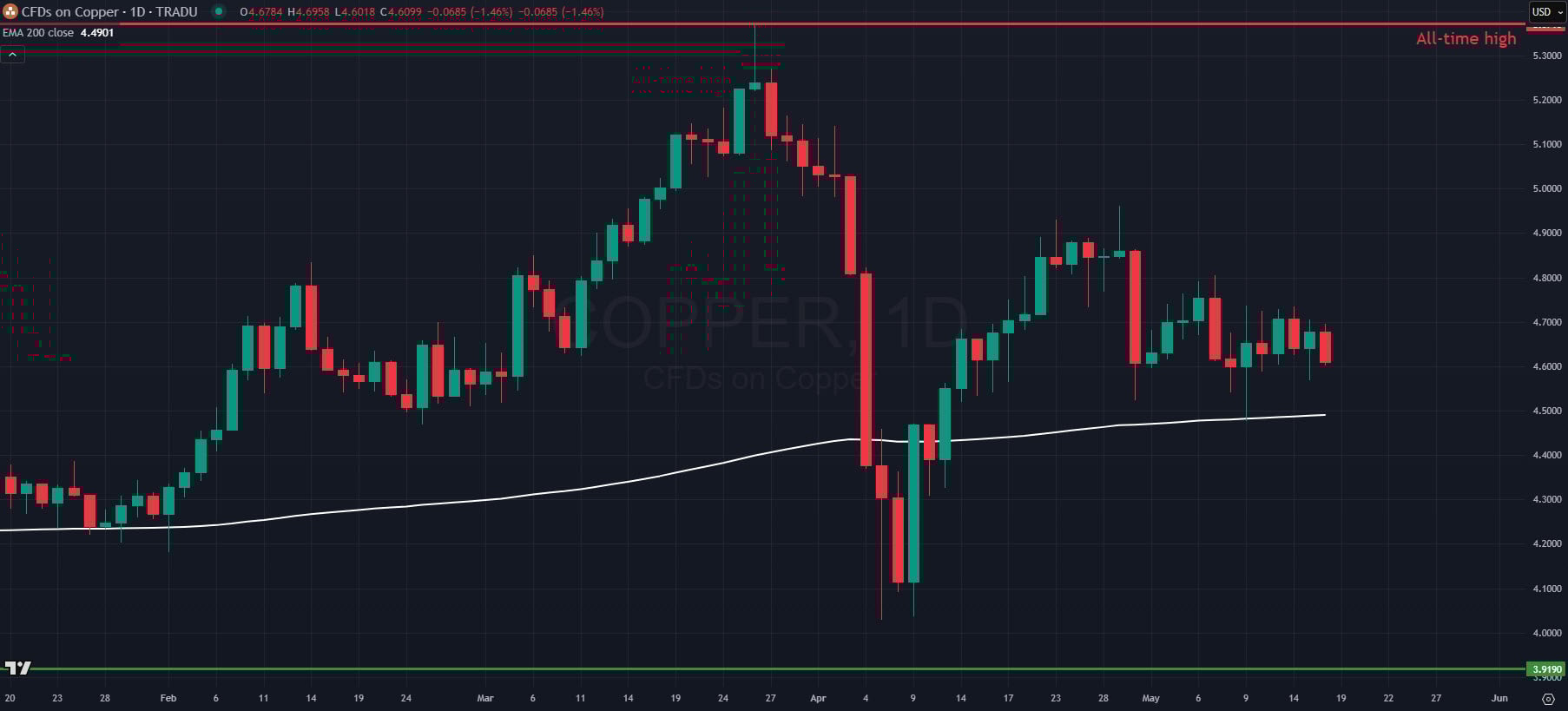
Source: www.tradingview.com
*Stratos clients.
Senior Financial Editorial Writer
Nikos Tzabouras
Nikos Tzabouras is a graduate of the Department of International & European Economic Studies at the Athens University of Economics and Business. With extensive experience in market analysis and a strong foundation in international relations, he brings a unique perspective to financial markets. Nikos emphasizes not only technical analysis but also on fundamentals and the growing influence of geopolitics on financial trends.
As a Senior Financial Editorial Writer, he delivers comprehensive and forward-looking insights across a wide range of asset classes, including equities, commodities, and currencies. His work explores how macroeconomic events, political developments, and global policies impact market dynamics, providing readers with a deeper understanding of both short-term movements and long-term trends.