
Shares
Apple gets tariffs reprieve, but challenges set to persist

The US President exempted smartphones and other electronics from his reciprocal tariffs, offering reprieve to Apple. Yet, he pointed to more levies ahead and the tech giant continues to face a difficult operating environment.

Apple faces a challenging environment
Apple is navigating a difficult period, with a lack of innovation leading to revenue stagnation and waning demand - just as competitors focus on new technologies and markets to drive growth. The company made a belated entry into Artificial Intelligence last year, but a slow and fragmented rollout failed to trigger a much-needed device upgrade cycle, leaving it vulnerable to rivals’ advancements.
While the global smartphone market grew by 7% last year, according to Canalys, Apple’s shipments declined by 1%. In stark contrast, Xiaomi saw a 15% surge [1]. Notably, sales in China dropped by 17%, causing Apple’s market share to fall, placing it in third position [2]. These figures highlight weak demand in a critical market and raise concerns over deeper structural issues.
Samsung is going all-in on AI, equipping its devices with a host of features, and expanding into new product categories. It has already launched a smart ring, is working on a Vision Pro competitor, and is even hinting at augmented reality glasses [3]. Meanwhile, China’s Xiaomi has expanded its vast portfolio with a successful move into electric vehicles (EVs) - an area Apple failed to crack.
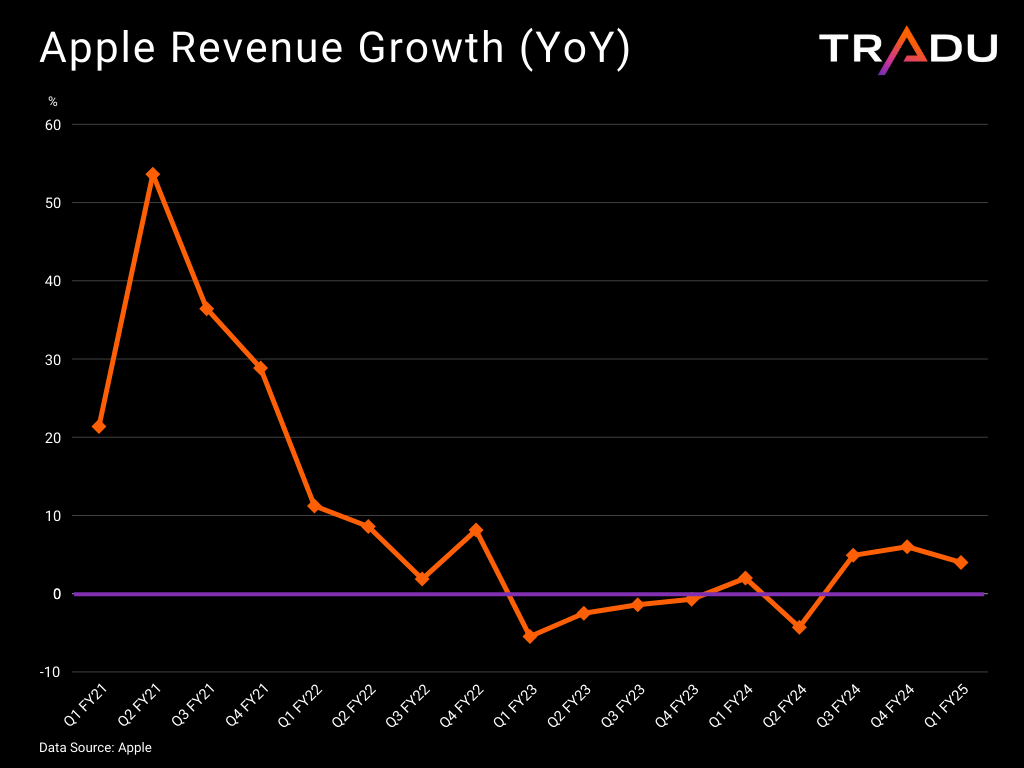
These headwinds are weighing on Apple’s financials. Revenue grew just 4% year-on-year in Q1 FY25 (quarter ended December), with management expecting this subdued trend to continue in the upcoming quarter [4].
US tariffs pose an existential threat to Apple
Earlier in April, the US President announced sweeping new tariffs [5], dubbing the move “Liberation Day”, aimed at boosting revenue and reshoring manufacturing. Key Asian partners and major Apple manufacturing hubs were hit hard, with tariffs of 46% on Vietnam and 32% on Taiwan. Crucially, Trump’s trade actions has led to a tit-for-tat with China. Beijing has imposed tariffs of 125% on US imports, while the US levies have risen to 145% (a 125% reciprocal tariff [6] and an additional 20% fentanyl-related [7]).
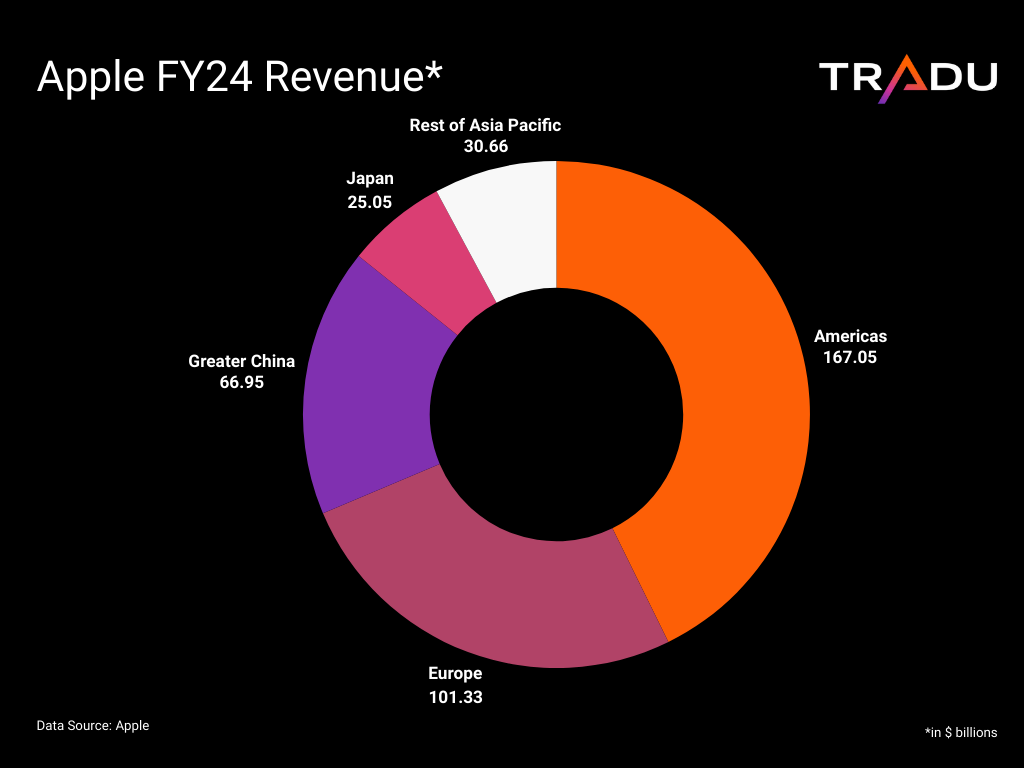
These disruptive trade policies represent an existential threat to Apple, compounding existing challenges. According to Apple’s FY2024 annual report (year ended September), its manufacturing is located “primarily in mainland China”, along with India, Japan, South Korea, Taiwan, and Vietnam [8]. Moreover, the majority of its revenue comes from outside the US, with China alone contributing $66.952 billion—nearly 20% of total sales for the year.
Not only this antagonism risks hurting the appeal of US goods abroad but can significantly drive up costs for Apple’s products and erode profitability. It can also lead to price hikes that could dent demand amid heightened fears of a global economic slowdown.
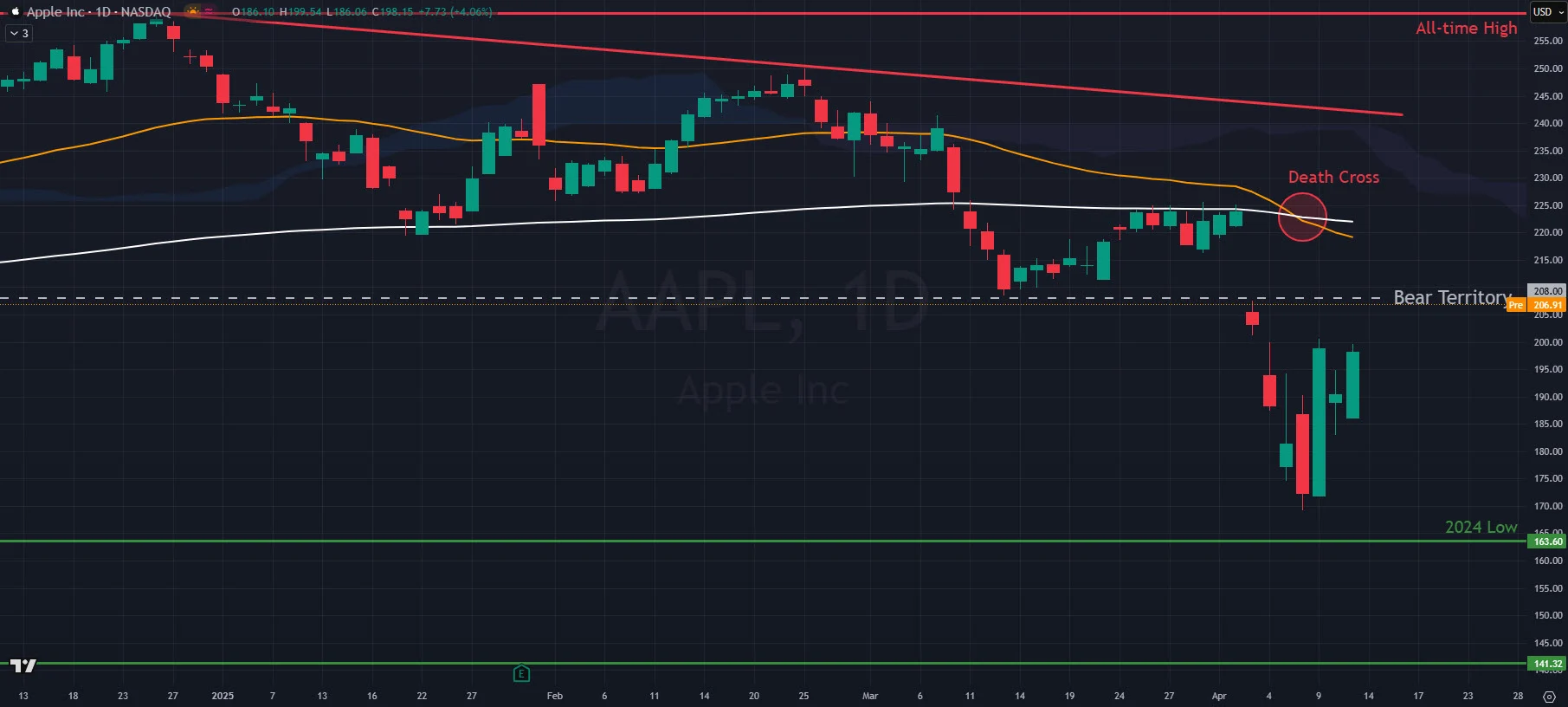
Shares of Apple shed over 20% year-to-date against this adverse backdrop and the formation of a Death Cross (EMA200 < EMA50) add to the technical hurdles that create scope for sustained weakness. This steep decline comes amid broader Wall Street turmoil, with the S&P500 remaining at risk of a bear market, while the consumer discretionary sector (XLY) is the worst performer, since these are the first expenditures households axe in an economic downturn.
Source: www.tradingview.com
Apple gets tariff relief, but hurdles set to persist
With recession fears mounting, inflation expectations rising, consumer confidence plunging, and Wall Street in turmoil, the President has signalled a temporary reprieve. Duties will be lowered to 10% for most countries over the next 90 days as trade negotiations are sought [9]. More significantly, smartphones, semiconductors, and other popular electronics are exempt from reciprocal tariffs according to a weekend statement [10], offering substantial relief to Apple.
However, imports of these products from China still face the 20% fentanyl-related tariff. The President also suggested additional tariffs may follow, noting ongoing investigations into semiconductors and broader electronics supply chains . On ABC’s “This Week”, Commerce Secretary Lutnick clarified that while technology products are excluded from reciprocal tariffs, they are included “in the semiconductor tariffs, which are coming in probably a month or two”. [12]
What’s next for Apple
The exemption of smartphones and electronics from reciprocal tariffs is a significant positive development for Apple. It makes the trade impact more manageable, and the company has several options to mitigate remaining challenges. Apple could shift more production outside of China and may choose to absorb some increased costs - rather than pass them on to consumers - given its strong profit margins.
The latest developments also show there is room for negotiations, with the Sino-US trade relations being of the outmost importance. Moreover, Apple may push for further exemptions. After all, it has already pledged to spend over $500 billion in US manufacturing [13], including servers that support Apple Intelligence. The news can also help AAPL recover further, as the lower valuation can make the stock more attractive, while the company’s strong financial position offers resiliency.
Nevertheless, trade uncertainty is set to persist, and the environment will remain fluid. With the administration pointing to incoming sectoral tariffs on technology products, pressure on Apple could persist. The macroeconomic outlook is adverse, due the disruptive trade policies. Fears of stagflation in the US and global economic slowdown from disruptive trade policies, can hit consumption due to households pulling back spending on non-essential items. These hurdles come on top of existing challenges form increasing competition, slow AI rollout, and the lack of a new growth avenue.
Senior Financial Editorial Writer
Nikos Tzabouras
Nikos Tzabouras is a graduate of the Department of International & European Economic Studies at the Athens University of Economics and Business. With extensive experience in market analysis and a strong foundation in international relations, he brings a unique perspective to financial markets. Nikos emphasizes not only technical analysis but also on fundamentals and the growing influence of geopolitics on financial trends.
As a Senior Financial Editorial Writer, he delivers comprehensive and forward-looking insights across a wide range of asset classes, including equities, commodities, and currencies. His work explores how macroeconomic events, political developments, and global policies impact market dynamics, providing readers with a deeper understanding of both short-term movements and long-term trends.